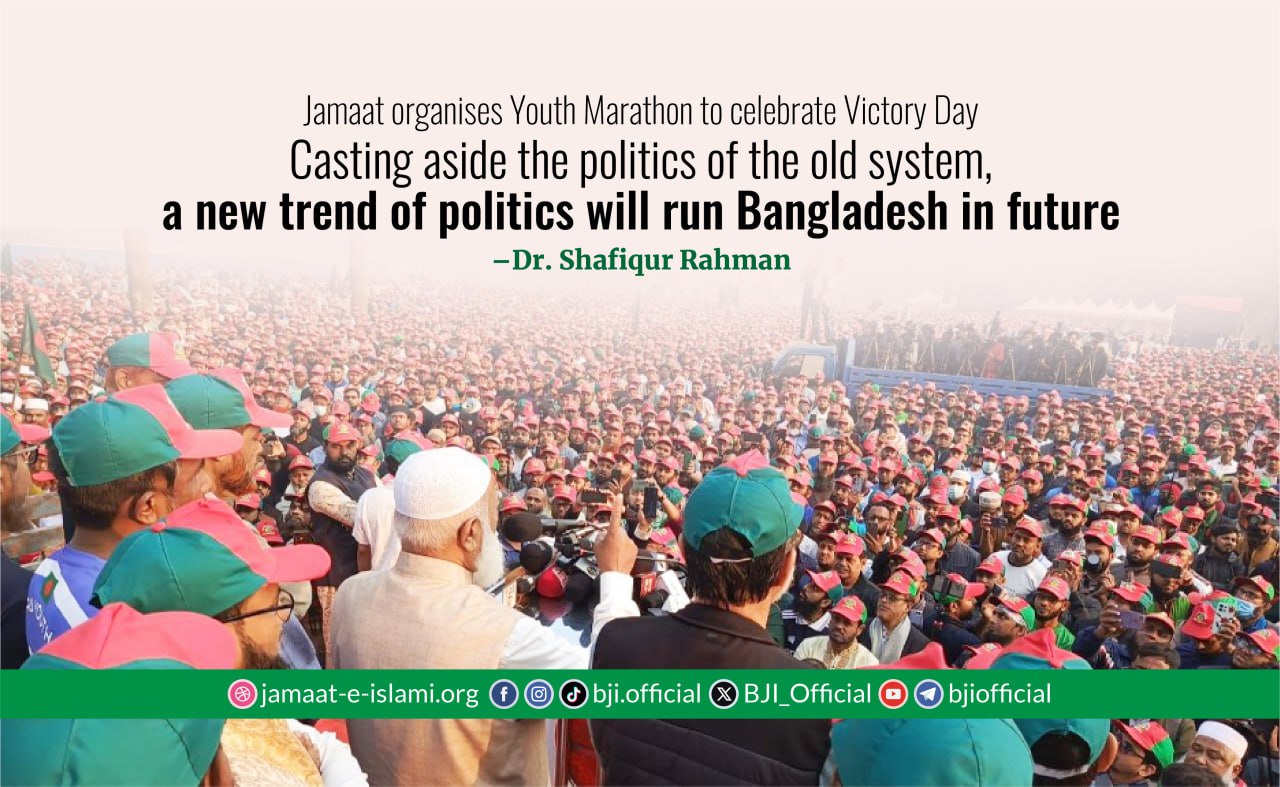
Bangladesh Jamaat-e-Islami's Ameer Dr. Shafiqur Rahman said, “Casting aside the politics of the old system, the Bangladesh of tomorrow will be run by the politics of a new system”—a politics that will stand against terrorism, extortionists, murder, rape, case-mongering, corruption, injustice, and all forms of oppression. He made these remarks while inaugurating the Youth Marathon organized by the Youth Department of Bangladesh Jamaat-e-Islami on 16 December, marking the Great Victory Day. He further said that the marathon will continue until a new Bangladesh of youth is built. “No matter how many obstacles or threats arise, we will not stop. We will build the nation’s dream of a new Bangladesh, Insha Allah.
He said that the people will not allow any kind of conspiracy or manipulation in the upcoming election. “We do not seek any favor from the Election Commission; but if the Commission shows favoritism toward anyone, it will not be tolerated.” Referring to attempts to buy people with black money, he said that people would respond with contempt. “People are far more aware than before. No one can buy a nation awakened by patriotism with black money.”
Jamaat Ameer said that because the ruling elite of Pakistan committed injustice and created discrimination against East Pakistan, people rose up in anger. Those who were elected in the 1970 election had promised the people that they would establish a non-discriminatory system of governance. But after independence, once in power, they broke their promises. They snatched away multi-party democratic rights, shut down newspapers, and took away people’s voting rights. By forming the Rakkhi Bahini, people were killed at will and the honor of mothers and sisters was violated. Through the establishment of BAKSAL, a dynastic system of rule was created. Sons of the Prime Minister and ministers committed bank robberies. Food and funds donated by foreign donor agencies were looted. Their four-and-a-half years of misrule turned the people rebellious. “Who killed them?”—they were killed at the hands of the national heroes who had led on the battlefield in 1971. Why they were killed—the Awami League should explore the answer.
They came to power three times—on 10 January 1972, 10 January 1996, and 7 January 2009. Before coming to power in 1996, they had admitted past killings and oppression committed by their party and had apologized to the nation. After the people placed them in power in good faith, they reverted to their true nature. The then Prime Minister went to Chattogram and declared that if one person from her party was killed, ten would be killed in return. How irresponsible must a Prime Minister be to make such a statement? At that time, people were killed and bodies were dumped in canals and wetlands. Later, on 28 October 2006, people were beaten to death like snakes at Paltan Mor. Not only that—after the killings, they danced on the bodies, a sight that pained the entire world.
After returning to power in 2009, they first carried out the Pilkhana massacre. One by one, they killed the top leaders of Jamaat-e-Islami. By carrying out killings at Shapla Chattar, they killed the country’s Islamic scholars. In their 15 years of rule, there is no locality where people were spared from the oppression of Awami League. As a result, during the July Movement, the entire nation rose up against them. Faced with public wrath, they became forced to give up office and fled the country. Now, from hiding, they are carrying out covert attacks. Their current targets are the youth and revolutionaries of this country. As part of that target, they attempted to assassinate Osman Hadi, one of the top heroes of July. If anything happens to Osman Hadi, the revolutionaries will not sit idle. The Awami League thought that if they could eliminate Osman Hadi or a few revolutionaries, they would succeed—but no! They cannot reduce the number of revolutionaries; rather, the number of revolutionary youths will continue to grow. The youth stand ready to resist all destructive forces of the Awami League. The Jamaat Ameer called upon the gathered youth to continue the marathon until a new Bangladesh is built.
At the inaugural meeting, Central Executive Council Member and Ameer of Dhaka City South Nurul Islam Bulbul said that, Jamaat-e-Islami is ready to build the new Bangladesh of tomorrow together with everyone. Today’s youth marathon delivers the message of a new trend of politics, moving away from the rotten, outdated politics of the past. He said that the independent Bangladesh we achieved in 1971 through nine long months of struggle did not ensure people’s freedom. Because the spirit of 1971 was not implemented, the July Revolution was achieved in 2024 with a new spirit to build a new Bangladesh. The new Bangladesh inspired by the spirit of July will be built—indeed, it will be. Without fearing bullets or bombs, the youth must take a firm pledge to build a new Bangladesh.
The inaugural event of the Youth Marathon was presided over by Assistant Secretary General of Bangladesh Jamaat-e-Islami Advocate Ahsanul Mahboob Zubair, and hosted by Central Majlish-e-Shura Member and Assistant Secretary of Dhaka City South Mohammad Kamal Hossain. Among others who addressed the meeting were Central Working Committee Member and Nayeb-e-Ameer of Dhaka City South Advocate Dr. Helal Uddin, and Central Majlish-e-Shura Member and Assistant Secretary of Dhaka City North Dr. Fakhruddin Manik. Central leaders as well as leaders from Dhaka City North and South were present on the occasion.
After the inaugural meeting, Jamaat Ameer Dr. Shafiqur Rahman formally inaugurated the Youth Marathon from Suhrawardy Udyan. Approximately fifty thousand young participants took part in the marathon. The marathon started from Suhrawardy Udyan and concluded at Manik Mia Avenue via Shahbagh and Science Lab.